Instigate Arts understands the difficulties faced by artists in today’s current climate, especially those who are marginalised for reasons of class, gender, sexual orientation and economics. We understand the challenges faced by independent venues across the country. We also know the impact art and ideas have on people’s wellbeing and society as a whole and so create projects intended to support artists and ideas, make new work and make positive social change.
Across June 2025, we sent five artists into five Salford drinking establishments. They were tasked to document folklore, rumours and memories of drinking in Salford pubs. From this each artist will archive stories and create a bespoke artwork to be displayed in the pubs during Salford’s centenary year. On the 14th and 15th August, we will be launching ‘Trails, Pales and Centenary Tales’. A trail map will link all five pubs, guiding visitors between venues.
1. Tell us about your practice?
My creative practice is writing, while in my professional life I’ve mainly worked as a creative producer, curator, and mentor. I primarily write fiction, mostly short stories, and at the moment these are largely gay historical short stories for a collection I’m working on. I’m interested in the faint traces and the absences in our archives and collective memories. Where there’s a tantalising suggestion of a life or an experience, that’s where I think fiction can rush in to imaginatively fill the spaces left behind. That’s what my collection of short stories The Skies Over Chelsea is about, which I am just about to finish writing. It’s also the reason I love heritage and heritage-inspired projects like ‘Trails, Pales and Centenary Tales’. It’s ultimately about people and their stories.
2. Can you tell us about yourself and your journey as a creative?
I come from a working class Irish family in Blackpool. I was reading and writing before I started school and my curiosity was always encouraged, but I always instinctively felt that certain paths were not available to me, so the things I wanted to pursue I never did, or I did so later in life. I would love to have written and published in my twenties, or be an actor, or work in film or television, but how could you go about those things? When I was a teenager my dad was a mechanic and my mum was a cleaner. Those sorts of creative careers were beyond imagining. It’s part of the class experience that isn’t always articulated. There is a narrative where the plucky individual has a dream, and with pure grit and raw talent they rise above their circumstances. The truth is that we often deselect based on our reality.
I was lucky I went to school in a middle class area so university was introduced as a possibility, one that I grabbed with both hands. I’ve been class-mobile ever since! Working in the arts is largely a middle-class experience, but the wages are not, so there are lots of people struggling, but doing so with the smiles and genteel acceptance of the middle class. It creates a gulf where it’s hard to ask for what you need to live, not to mention the fact that class is rarely put forth as a meaningful measure of diversity and inclusion.
Because my working life has been about supporting other artists, my own creative practice has been neglected for long periods of time. It’s one of the great sorrows of my life. When I was working full time I was also DJing every weekend and I used my DJ money to pay for an MA in Creative Writing. I loved it. I wrote a great novel that lots of people praised, but I couldn’t find a publisher for it. It’s such a setback, creatively and spiritually. Then you get into a rut. Too tired to write, too rejected to submit, too anxious to be inspired, too broke to do it all again for free. I tried not writing at all, and that was the worst feeling of all. When I do write though, good things happen. I have been nominated for several literary awards, published in five countries, and even had my work translated.
Right now, I’m working on the final story for my collection and I have found a publisher who is interested in reading it. There are no guarantees of course, but this is the closest I have come to my dream of having a book on the shelf that I wrote myself. This is the same dream I have had since I started school.
3. How has the Salford Centenary project changed how you feel about your own practice?
Being commissioned to write in a setting like the Salford Centenary project for Instigate Arts is really uplifting for me. The freelance world right now is disastrous, funding has been cut all over the place and often I don’t know where my next bit of income will appear from. In the midst of this, to be recognised, commissioned, and paid as an artist who has value is tremendously validating. I feel like myself again. I aim to do this project proud, and I will. I am working hard to produce something that’s authentic, historically researched, moving and interesting, and which also has a legacy.
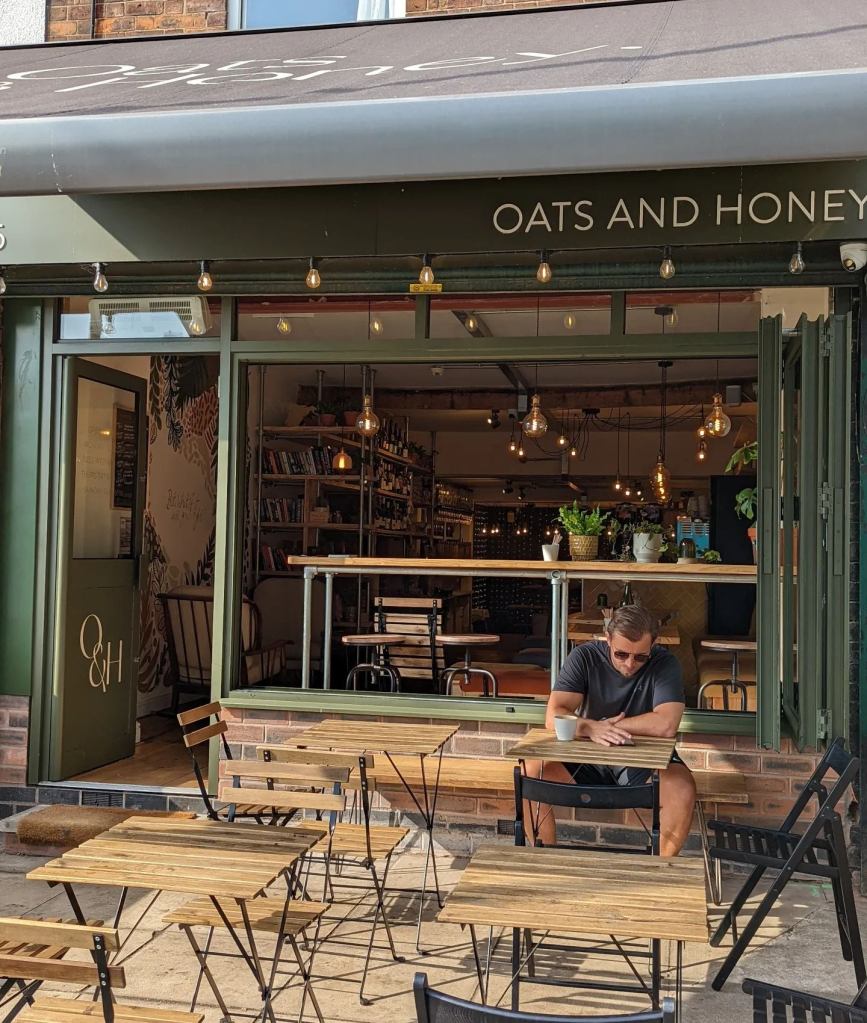
My venue is Oats & Honey. The customers have been some of the most interesting and warm people you could meet – of course because it’s Salford! In between the fascinating conversations and the many many oat flat whites (and the occasional lager) I also looked into the history of their beautiful building. It turns out the venue has always had a part to play in village life in Monton, and not in ways you might expect. I am excited to find a way to thread these old and new experiences together, to somehow connect the Salfordians of today with their predecessors.
I’ve done heritage projects before, for example at London Road Fire Station, and I love the energy and engagement of the process. This project has made me determined to bring more of this into my future work. Contemporary people and their stories are always endlessly fascinating to me, but what also strikes me is how real the emotions are when you encounter people from the past, whom nobody might have thought about in decades, or centuries even. One of my past projects looked into the collapse of Islington Mill in Salford in 1824, where 18 workers were killed. Their names had been recorded incorrectly or incompletely. Nobody knew where they were buried. As I gathered this information with much painstaking research I felt bound to them, and angry for what had happened. When we eventually held a memorial service it was extremely cathartic and I shed a tear.
4. Why do you think the themes of trails, pales and centenary tales are important in the current social, economic and political environment?
I despise celebrity culture. I wish I could forget every bit of trash I have ever absorbed about famous people. ‘Ordinary’ people are seldom ordinary. They have enjoyed and endured lives that are compelling and wondrous to me. The most humble self-effacing folk often have the most astounding stories. Give me a plumber, a wainwright, a hat-seller, or a barmaid any day over a prince, a model or a movie star. Projects like this are an antidote to the superficial celebrity world that’s constantly pushed onto us. I don’t care! Let’s get a coffee and you can tell me all about yourself!
Specifically though, I think celebrating Salford’s heritage, past and present, is so important because the North in general is so undervalued, and because Salford is so often in the shadow of the city next door. There’s a pride and unique character that’s hard to describe but easy to feel when you’re in Salford. I worked there for many years and I love it still. Absorbing life through stories, in a relaxed but vibrant place like Oats & Honey, reminds me how important these spaces are, thoughtfully curated, devoted to their local community, independent, full of character and characters. The nature of our cities is so delicate and it needs both chronicling and celebrating.
5. Part of this project involves receiving coaching support from the brilliant Salford based organisation Result CIC. How has this been for you?
My coaching came at a valuable time for me. I recently learned I have a neurodivergent condition which helps explain so many of my struggles since childhood. I was able to speak to a peer who understood the real tribulations of a creative life and temperament. Our weekly check-ins gave me space to think aloud about where I was heading in my career and my artist journey, and what was worrying me. The ‘homework’ tasks helped me take stock and value how far I had already come. Even as a working mentor myself, talking about myself can seem indulgent, but my coach made it feel easy and fun.
6. What has working with Instigate Arts made possible that wouldn’t have happened otherwise?
The free coaching support! The boost to my confidence when I needed it. The fair pay. The chance to be part of a team shaping a project. The acknowledgement and acceptance of my barriers in life. The chance to be back in Salford. A return to heritage work and oral history. Some delicious free flat whites! Some inspirational conversations with diverse and wonderful folk. I could go on. Is it impossible to wish that life could be like this for all of us, all of the time?
Read profiles of all of the Instigate Arts Salford 100 artists here.


Leave a Reply